

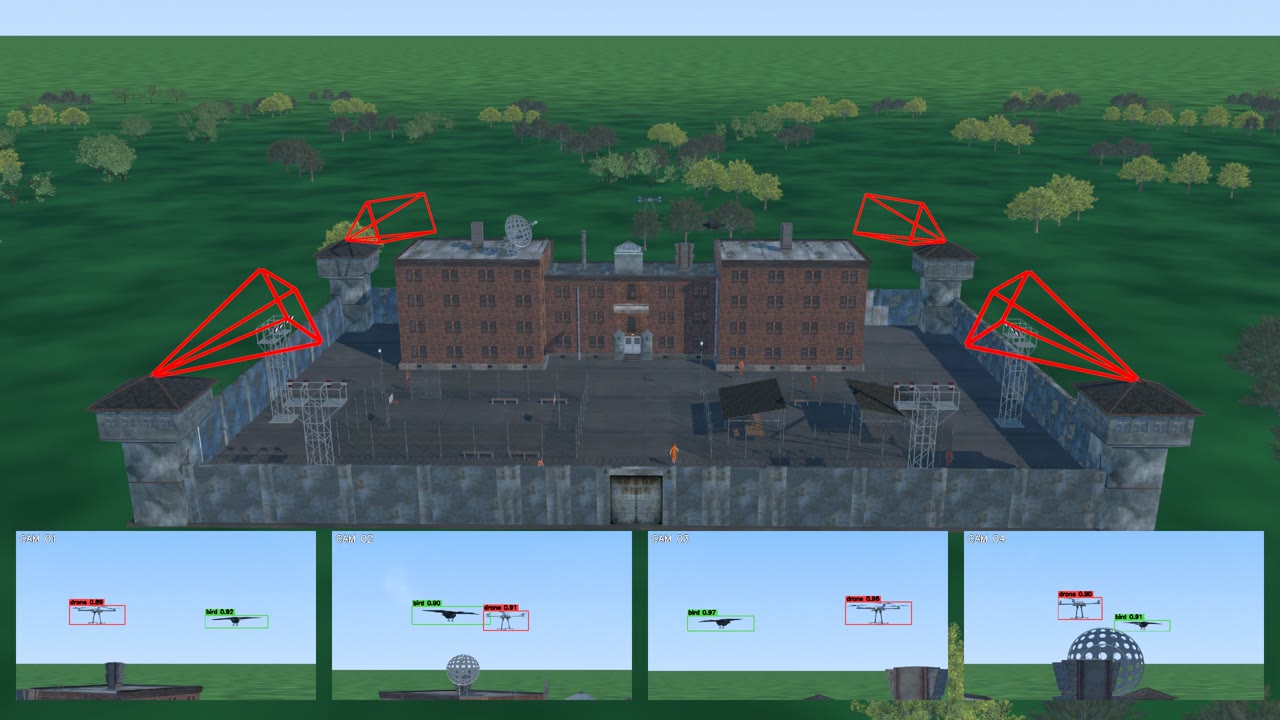
TL;DR: MambaSplat-4D classifies sequences of 3D Gaussian Splats (bird, drone, airplane, helicopter) with predictions that are rotation-invariant by construction, even when every frame is rotated independently.
Abstract
While 3D Gaussian Splatting (3DGS) has revolutionized real-time rendering, its potential for spatial-temporal understanding remains underexplored. Feed-forward 3DGS now enables near-real-time per-frame reconstruction from multi-view images, making temporal sequences of Gaussian Splats a practical representation for dynamic scene modeling, yet existing methods either use point clouds, lack guaranteed rotation invariance, or cannot handle temporal sequences.
We present MambaSplat-4D, a rotation-invariant architecture operating directly on the full 14-parameter feed-forward 3DGS representation (position, quaternion, scale, opacity, and DC color) in three stages: a Gaussian Lifting procedure maps all coefficients into an equivariant feature space, where a Vector Neuron transformer captures inter-Gaussian relationships; the VN-In bridge, a learned equivariant-frame projection at the spatial–temporal boundary, converts these features into rotation-invariant scalars, recovering up to the 3C−3 independent SO(3) invariants when the pooled feature is full-rank; and a Mamba state-space model encodes temporal dynamics in linear time, enabling efficient classification of dynamic Gaussian Splat sequences. The projection is invariant for any learned frame, so predictions are invariant by construction under arbitrary (per-frame) SO(3) rotations. On static 3DGS benchmarks VN-In is level with the VNStdFeature bridge at a matched ~27k bridge budget, and on temporal 4D benchmarks it reaches VNStdFeature's accuracy with 75× fewer bridge parameters. To enable evaluation of temporal 3DGS classification, we release AeroSplat-4D, a synthetic dataset pairing temporal 4DGS sequences with aerial object classes, with its generation pipeline, the MambaSplat-4D architecture, and evaluations.
In short: 3D Gaussian Splatting represents an object as thousands of small coloured 3D ellipsoids; Vector Neurons are network layers whose features rotate together with the input; Mamba is a state-space sequence model whose cost grows linearly with the number of frames.

Gaussian Lifting
Four co-rotating lifting vectors, derived from each Gaussian's quaternion and anisotropic scale, let a Vector Neuron network process the complete 14-parameter 3DGS representation equivariantly.
VN-In Bridge
A learned equivariant-frame projection turns C equivariant feature vectors into 3C rotation-invariant scalars, recovering up to the 3C−3 independent SO(3) invariants when the pooled feature is full-rank, at a fraction of the parameters of prior learned-frame extractors.
End-to-end 4D pipeline
A VN-Transformer spatial encoder and a Mamba state-space temporal encoder are joined through the bridge and trained end to end without pre-training. Temporal cost is linear in the number of frames.
AeroSplat-4D benchmark
A temporal 3DGS dataset, evaluated under a four-setting rotation protocol that separates architectural invariance from augmentation. Released with code and models.
Architecture
MambaSplat-4D extracts rotation-invariant representations from the full 3DGS parameterization in four stages. Invariance rests on a single mechanism, the equivariant-to-scalar projection at the spatial–temporal boundary; everything before it is equivariant and everything after it acts on scalars.
- Input. A sequence of T frames, each a set of N Gaussians with 14 parameters: centre (3), rotation quaternion (4), log-scale (3), opacity (1) and the DC spherical-harmonic colour (3). The paper's operating point is N = 512 and T = 16.
- Gaussian lifting. The position and the three scaled principal axes from the quaternion and scale form four vectors that co-rotate with the object. Opacity and colour, which are rotation-invariant, are fused alongside them.
- VN-Transformer. Vector Neuron attention and feed-forward blocks encode relationships between Gaussians while keeping every feature equivariant.
- VN-In bridge. The pooled per-frame features are projected onto a learned equivariant frame. The resulting 3C scalars are invariant to any rotation of that frame's input, so each frame may be rotated independently.
- Mamba temporal encoder and head. Four Mamba blocks with sinusoidal positional encodings model the scalar sequence in linear time; mean pooling over frames and a two-layer MLP produce the class logits.
AeroSplat-4D
AeroSplat-4D is a synthetic 4D Gaussian-splat benchmark for airborne-object classification. Animated 3D assets are rendered in NVIDIA Isaac Sim on a blank stage by four static cameras 90° apart, at two elevations and ten radii from 2 m to 280 m, for 30 frames at 30 FPS. Every frame is reconstructed into 3D Gaussians by a feed-forward reconstructor and cached as a fixed-size tensor. Splits are identity-disjoint: no asset appears in more than one split.
The assets
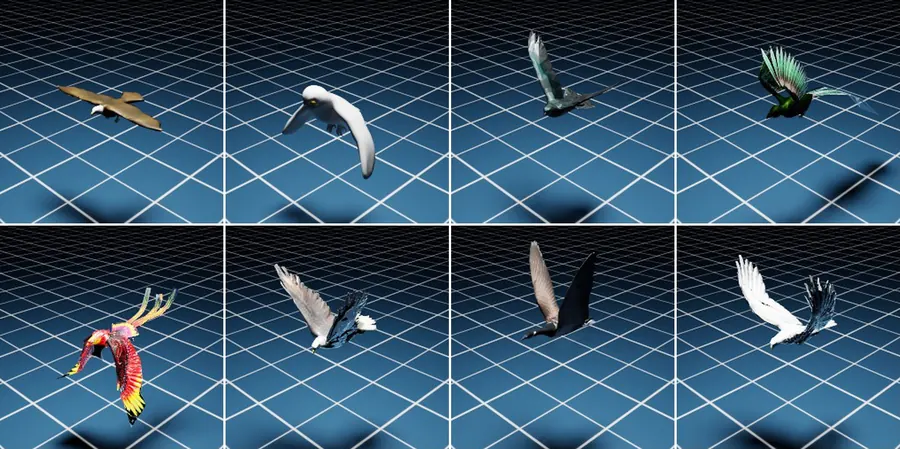
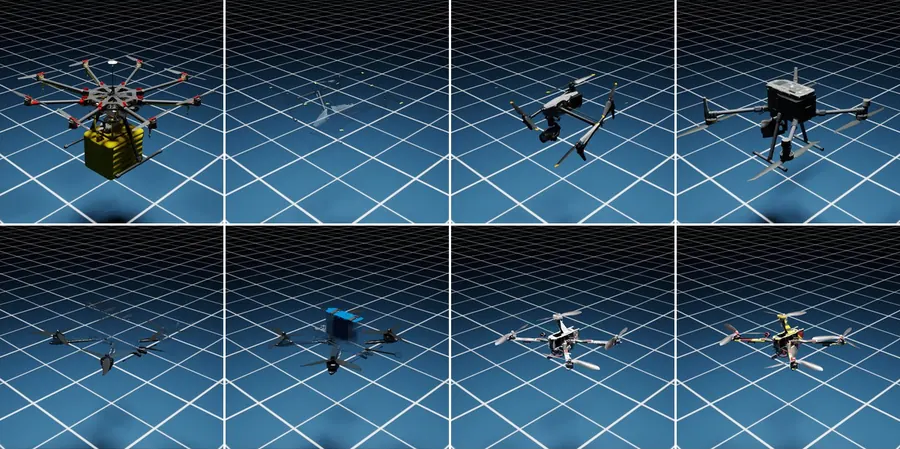
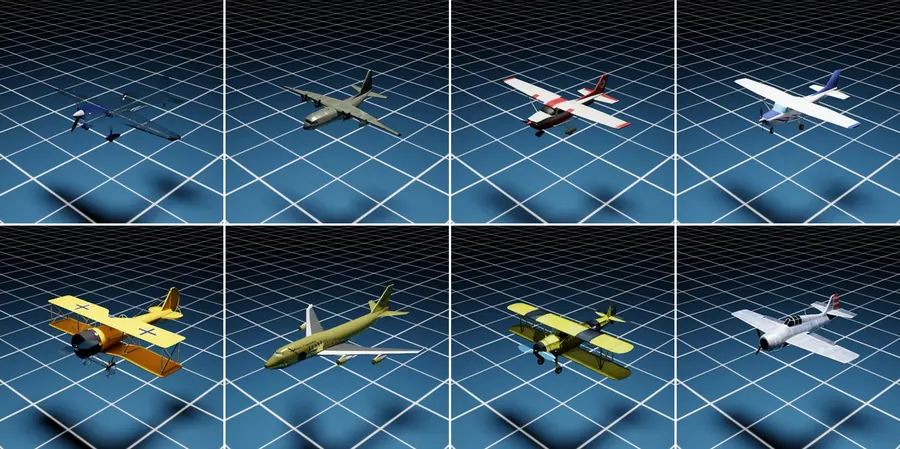
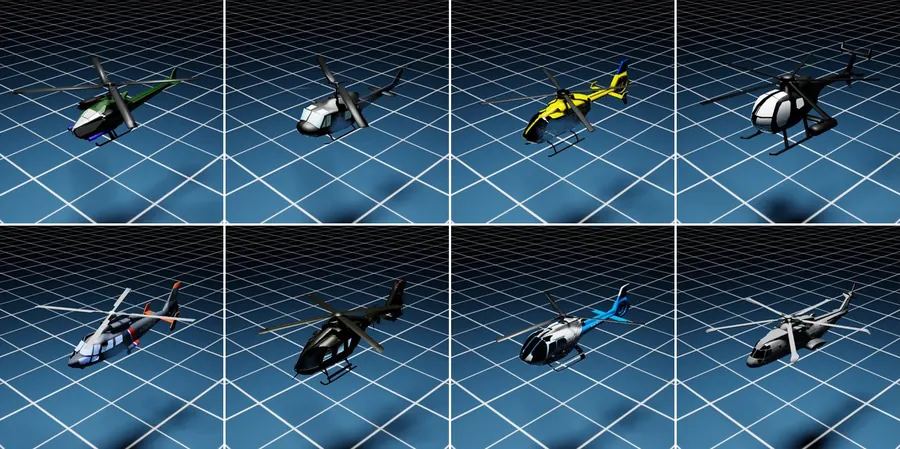
Eight assets per class shown; every asset is animated (wing-beat, rotors, propellers).
From four views to 3D Gaussians
Each frame is lifted to 3D Gaussians in one forward pass of LGM from the four camera views. One frame per class, orbited:
What the network sees
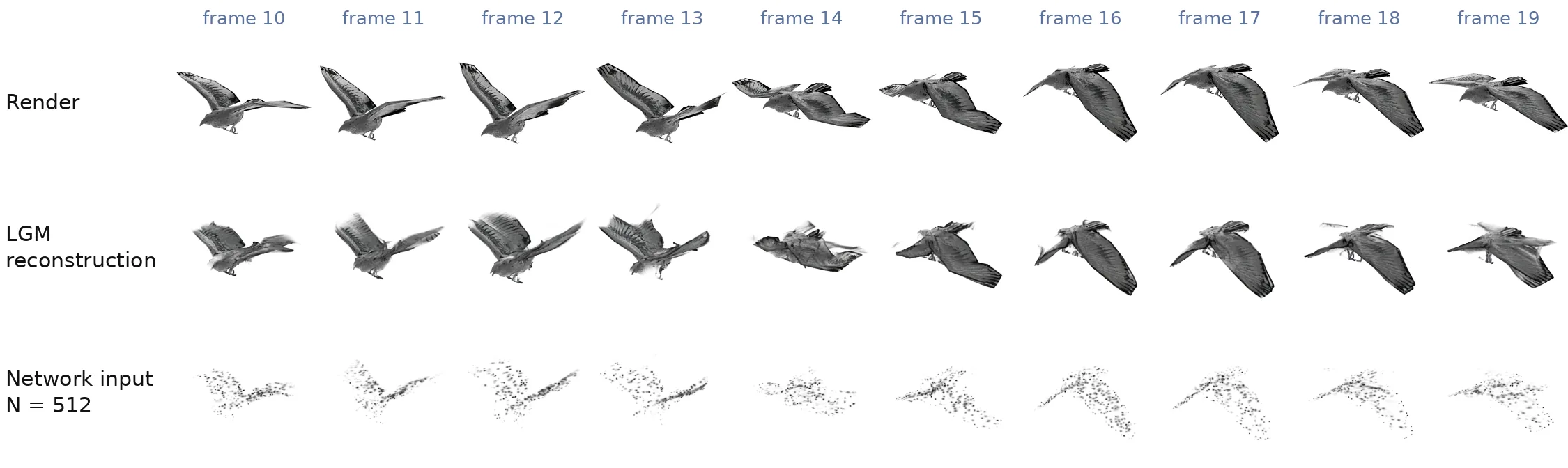
Each reconstruction is cut down to a fixed set of N = 512 Gaussians per frame (random draw, farthest-point sampling, random draw) and normalised to the unit sphere. The classifier never sees pixels, only these Gaussians and how they change over the 30 frames.
How each class moves
The temporal encoder classifies from how the Gaussian set changes over time. The Chamfer distance of every frame to the first makes that change visible: a wing-beat returns periodically, rotors flicker, a rigid airplane stays flat.
Download
The feed-forward-reconstructed, preprocessed dataset (3.2 GB) with a sha256 manifest and the identity-disjoint split file. Source assets and Isaac Sim scenes are not redistributable and are not part of the release. Licence: per asset (CC BY 4.0, CC BY-SA 4.0 or CC BY-NC 4.0), see ATTRIBUTION.md.
Acknowledgements
This project was sponsored by Wim Bos, CEO of Lumiad, and carried out within the Lumiad Extended Technologies (LXT) department in collaboration with Spacecific. And to Remi, for the fruitful discussions that shaped this work.
Asset credits
All 3D models were modified: converted to USD, rescaled, re-oriented, given rotor animation where applicable, and rendered in NVIDIA Isaac Sim or Blender. The full list of models in AeroSplat-4D is in ATTRIBUTION.md.
Demo video and header
- The Prison by Veterock, CC BY 4.0
- Prisoner by Dakta.Grower.Nzl, CC BY 4.0
- Prisoner by asadkhan1881, CC BY 4.0
- Prisoner Idle by Decentralized, CC BY 4.0
- Tree wind system by Node_λrt, CC BY 4.0
- Tree Animate by Node_λrt, CC BY 4.0
- Animated Oak Trees by Jagobo, CC BY 4.0
- Crow by Alexei Ostapenko, CC BY 4.0
Reconstruction, network-input and motion figures
- Crow by Alexei Ostapenko, CC BY 4.0
- DJI Inspire 3 by polyman Studio, CC BY 4.0
- Attack Helicopter by ssoh, CC BY 4.0
- Cesna Airplane by Hardy Noer, CC BY 4.0
Asset overview
- Bald Eagle - Med poly by Urielgc, CC BY 4.0
- Day 20 - Snowy Owl by Lilly!, CC BY 4.0
- Paloma_animada by accdecer, CC BY 4.0
- Quetzal Animation & Texture Test by Christian-Gomez, CC BY 4.0
- Phoenix by NORBERTO-3D, CC BY 4.0
- Animated Eagle by Clement Abai, CC BY 4.0
- Canada Goose - in Flight by osuecampus, CC BY 4.0
- White Eagle Animation Fast Fly by GremorySaiyan, CC BY 4.0
- DJI Drone Dji Drone by 3watteze, CC BY 4.0
- DJI INSPIRE 2 with ZENMUSE X5S by geoffreycouppey, CC BY-NC 4.0
- DJI Inspire 3 by polyman Studio, CC BY 4.0
- Quadcopter DJI Matrice 300 RTK by 19vitali99, CC BY 4.0
- FPV kamikaze drone Low-poly by Kvasovich, CC BY 4.0
- Drone racing by 3D Husky, CC BY-SA 4.0
- Attack Helicopter by ssoh, CC BY 4.0
- Bell Huey helicopter by Duane's Mind, CC BY 4.0
- EC 135 by GRIP420, CC BY 4.0
- MD-500 Defender Helicopter by Duane's Mind, CC BY 4.0
- Airbus-Helicopter S365 Dauphin by helijah, CC BY 4.0
- Helicopter EC135: Special Forces by Neakster, CC BY 4.0
- Helicopter by surveytown, CC BY 4.0
- Merlin MK2 Helicopter by sudreyskr, CC BY 4.0
- Aerobatic Airplane by Kemal Çolak, CC BY 4.0
- cargo aircraft by RizalHardi, CC BY 4.0
- Cesna Airplane by Hardy Noer, CC BY 4.0
- Low-poly Airplane by MaX3Dd, CC BY 4.0
- Vintage Toy Airplane by berilbasak, CC BY 4.0
- Airplane by Tomations, CC BY 4.0
- BOEING-STEARMAN MODEL 75 by Stéphane Agullo, CC BY 4.0
- Grumman F4F Wildcat Airplane by Kohl 3D, CC BY 4.0
BibTeX
@inproceedings{verdiesen2026mambasplat4d,
  title     = {{MambaSplat-4D}: Rotation-Invariant {4D} Classification of {Gaussian} Splatting Sequences},
  author    = {Verdiesen, Alessandro and Hofstee, H. Peter and Al-Ars, Zaid},
  booktitle = {Asian Conference on Computer Vision (ACCV)},
  year      = {2026}
}